Printable 1200 Calorie Diet Meal Plan (PDF)
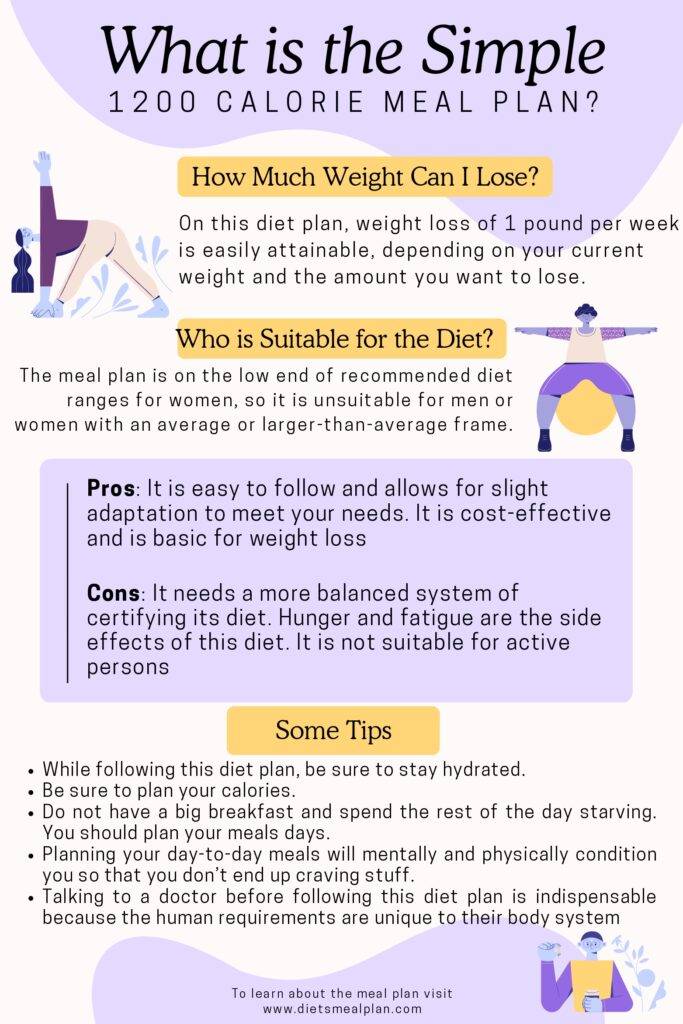
Talking to a doctor before following this diet plan is indispensable because the human requirements are unique to their body systems (what works for others may harm you).
The simple 1200-calorie diet plan is geared toward predictable weight loss goals.
On the 1200-calorie diet plan, weight loss of 1 pound per week can be expected for some individuals, but the results can vary depending on the physical activity level, metabolic rate, and current weight. This plan is not intended for everyone, however.
The 1200-calorie diet may be more suitable for small-framed individuals, but assessing personal energy needs through professional guidance is important.
The 1200 calorie meal plan is on the low end of the recommended diet range for women, so this diet is unsuitable for men or women with an average or larger-than-average frame.
In addition, the 1200-calorie meal plan is best suited for women over 50.
As we age, losing weight becomes more complex, and this diet plan helps promote weight loss when it is difficult.
Summary Comparison of 1,200 kcal Plan Variants
Save as PDF| Plan variant | Focus | Macros (approx.) | Best for |
|---|---|---|---|
| Balanced 1,200 kcal | All food groups, moderate carbs | 45% carb / 25% pro / 30% fat | Sedentary women, adults over 50 |
| High-protein 1,200 kcal | Satiety, lean-mass preservation | 35% carb / 35% pro / 30% fat | Hunger management, resistance training |
| Low-carb 1,200 kcal | Blood-sugar control | 25% carb / 30% pro / 45% fat | Insulin resistance (with clinician review) |
| Plant-forward 1,200 kcal | Fiber, phytonutrients | 50% carb / 20% pro / 30% fat | Vegetarian preference (add B12) |
| Mediterranean 1,200 kcal | Olive oil, fish, produce | 40% carb / 25% pro / 35% fat | Cardiometabolic risk reduction |
How 1,200 kcal Fits (Who This Target Is For)
A 1,200 kcal target sits at the low end of the recommended intake window for adults. The 2013 AHA/ACC/TOS obesity guideline (Jensen et al., PMID 24222017) lists 1,200 to 1,500 kcal per day as an appropriate calorie-counting range for women during weight loss, and 1,500 to 1,800 kcal per day for men.
The USDA Dietary Guidelines for Americans 2020-2025 estimate energy needs at roughly 1,600 to 2,000 kcal per day for sedentary adult women and 1,600 to 2,400 kcal for older adults. A 1,200 kcal intake typically creates a 400 to 800 kcal daily deficit for those groups, in the range NIDDK weight-management guidance associates with 0.5 to 2 lb per week of loss.
This target usually fits: sedentary women, women over 50, and shorter-framed adults trying to lose weight under clinician guidance.
Size up (aim for 1,500 to 1,800 kcal) if you are: male, under age 50, taller than about 5’6″, exercising more than three days per week, pregnant or breastfeeding, or managing a chronic condition that needs stable energy intake.
What is the Simple 1200 Calorie Meal Plan?
The 1200-calorie meal plan is a weight loss diet plan that allows most followers to lose at least 1 pound per week. This diet plan works by minimizing the calorie intake of the follower.
The average woman requires 1500 calories daily for weight loss and 2000 for regular weight maintenance.
This diet, however, strictly places you on a calorie count of 1200 daily. It has no stringent limitations on your diet, but the calorie count must be followed closely.
How Does a 1200-Calorie Diet Plan Work?
The 1,200-calorie diet plan works by reducing the calories the body requires daily.
This reduction aims to make the body’s metabolic processes seek another energy source to make up for the reduction in calorie count.
Studies show that the next energy source to use up is to cover the reduction in the fat in the body. Therefore, by burning this fat, weight loss is achieved conveniently.
However, it is essential to note that the progress and success of this diet plan are primarily dependent on your current weight, age, medical history, and other factors that require you to discuss with your doctor before starting it.
Following the Simple 1200 Diet Plan
The 1200 diet plan doesn’t have phases or stages. It is an easy-to-understand diet plan. Following this diet plan means your total calorie count must be within and not more than 1200 calories per day.
You can get help from apps to make calorie counting more accessible, such as Myfitnesspal, Loseit, Cron-o-meter, Fatsecret, Sparkpeople, and more.
This diet plan accounts more for weight loss than weight maintenance. Therefore, you must have a weight goal and ensure you do not lose body mass alongside body weight.
When you have reached your desired weight goal, you can increase your calorie intake but continue eating healthy meals to maintain weight.
You May Need A Stricter Discipline Than Usual When Following a Simple 1200 Calorie Meal Plan
As a follower of this diet, more discipline than you can imagine is required, mainly if you are used to a high caloric intake.
This is because your body may experience hunger while you make this switch. Talking to a doctor before starting this diet is another good reason.
To tackle the hunger that accompanies following this diet, it is essential to eat healthy food that will fill you for a longer period.
Sustain your appetite by consuming healthy and filling foods moderately. Examples of good foods to choose from include
- Watermelon,
- Salad,
- Grapefruit,
- Vegetables,
- Fruit with high water content and more.
Keep Your Nutrition Intake In-Check
The diet allows for snacks in your meal plan, and you should eat six times a day with snacks between the three meals.
It will also enable you to engage in less rigorous exercise, which can be dangerous when in a caloric deficit, to facilitate your weight loss goal.
While following this diet plan, ensure that your simple 1200 calorie meal plan is a rich blend of a balanced diet.
This is important so you are not nutrient deficient in any capacity and to ensure that you drink water regularly to stay hydrated and control your appetite.
Which Foods to Avoid on a Simple 1200 Calorie Diet Plan?
As earlier stated, while shedding light on what the 1200 calorie diet plan is, the food to avoid while following this diet plan is an unwritten code.
Avoiding certain foods is not strictly stated, but avoiding them is in your best interest, so you don’t stay long on this diet plan.
Most of the food items listed here are exempt for anyone with a weight loss goal, regardless of the diet plan they follow.
Avoid the Following Foods:
- Soft drinks: Juice, aerated drinks, and any drink that contains artificially added sugars/sweeteners.
- Alcohol: Because it contains sugar, which can increase your blood sugar level.
- Fried foods: Fried snacks, etc.
- Carbohydrates: Rice, pasta, candy, and other simple carbohydrates, because they make you hungry quickly and they are high in glucose. At best, make sure you limit their intake substantially.
- Fat: Food items that are rich in fat
What Foods Can You Eat on a 1200-Calorie Diet Plan?

- Complex carbohydrates keep you full for a long time. Examples are whole-grain bread or toast, bran, whole-grain pasta, high-fiber foods, and more.
- Bananas, Cucumber, tomatoes, peaches, apples, grapefruits, and other non-starchy vegetables and fruits.
- Because of their low fat and calorie content, canola oil, peanut oil, mustard oil, olive oil, and vegetable oil.
- Lean proteins include beans, lentils, tofu, mushrooms, turkey, fish, and low-fat chicken.
- Your meal plan must contain a balanced diet while staying within your calorie count.
If you are interested in a diet-specific 1200 calorie diet plan, the printable table below may be handy.
Some Tips to Follow Under Your 1200 Calorie Diet Plan
- While following this diet plan, be sure to stay hydrated. Try to have at least 3 liters of water daily to keep your digestive system healthy and functioning properly.
- Also, be sure to plan your calories.
- Do not have a big breakfast and spend the rest of the day starving. You should plan your meals days.
- Planning your daily meals will mentally and physically condition you so you don’t crave stuff.
Let’s dive into the 1,200-calorie-a-day meal plan now.
Nutrient Adequacy at 1,200 kcal
Cutting calories to 1,200 shrinks the food volume that must deliver every essential nutrient. Deficiency risk rises for several nutrients that women (the primary audience for this target) already tend to under-consume.
- Protein. Aim for at least 1.0 to 1.2 g per kg body weight to preserve lean mass. Higher-protein hypocaloric diets improve satiety and weight-loss outcomes (Leidy 2015, PMID 25926512).
- Calcium. Adult women need 1,000 to 1,200 mg per day (NIH Office of Dietary Supplements). Include dairy, fortified plant milk, or leafy greens at most meals.
- Iron. Premenopausal women need 18 mg per day. Pair non-heme sources (lentils, spinach) with vitamin C to boost absorption; postmenopausal women need 8 mg per day.
- Vitamin B12. RDA 2.4 mcg per day. Real shortfall risk on plant-forward variants without fortified foods or a supplement.
- Vitamin D. 600 to 800 IU per day. Difficult to obtain from food alone at 1,200 kcal; a supplement is often warranted.
- Fiber. 25 g per day for women. Build meals around whole grains, legumes, vegetables, and fruit.
If two or more of these nutrients are hard to hit consistently, a basic multivitamin is a reasonable insurance policy alongside a food-first plan.
Pros and Cons of the Simple 1200 Calorie Meal Plan
Pros
- It is easy to follow and allows for slight adaptation to meet your needs. This is why seeing your doctor is important.
- It is an efficient weight-loss mechanism.
- It is cost-effective and is essential for weight loss
Cons
- It needs a more balanced system of certifying its diet.
- Hunger and fatigue are the side effects of this diet
- It is not suitable for active persons
Frequently Asked Questions About Simple 1200 Calorie Diet Plan
How easy is it to follow this diet?
The diet is easy to follow, allowing for mild adjustments to suit your needs. However, when transitioning to it, calorie requirements may be detrimental to your body, so it allows for slight considerations.
How weighty are the advantages against the disadvantages of this diet plan?
The advantages outweigh the disadvantages. It is noteworthy that the disadvantages can be mitigated by making slight adjustments, which should not reasonably cast doubt on the necessity of the diet.
Is the 1200 calorie diet plan safe and effective for weight loss?
The 1200 calorie diet plan is considered a healthy way of losing weight. However, you should ensure you are consuming the right amount of minerals and vitamins while on a low-calorie diet.
What are the benefits of a 1200 calorie diet?
People on a 1200 calorie diet can benefit from substantial weight loss, as well as preventing complications of excess weight or obesity.
How can you balance your foods in order to take all the essential vitamins and minerals?
Consuming a varied diet that includes whole foods such as vegetables, fruits, eggs, meat, and fish is helpful in maintaining an appropriate balance of nutrients. However, it is recommended to consult your dietitian to address this issue.
Extended FAQ
Is 1,200 calories safe long-term?
For most adults, 1,200 kcal is a short-term weight-loss intake, not a maintenance target. AHA/ACC/TOS guidance frames it as part of a defined reduction phase, typically 3 to 6 months, after which intake should transition upward toward a maintenance level. Long-term intake below your resting energy expenditure raises the risk of nutrient shortfall and lean-mass loss.
How much weight will I lose on 1,200 kcal?
Typical loss is 0.5 to 1.5 lb per week, depending on starting weight, activity level, and how far 1,200 kcal sits below your maintenance intake. The rate slows over weeks as the body adapts and total energy expenditure drops with weight loss.
Can I exercise on 1,200 calories?
Light to moderate exercise (brisk walking, yoga, resistance training 2 to 3 times per week) is compatible with 1,200 kcal if protein intake is adequate. Heavy endurance training or 5+ high-intensity sessions per week usually requires more fuel; step calories up on those days or raise overall intake to 1,400 to 1,600 kcal.
What if I’m still hungry?
Prioritize 25 to 35 g protein at every meal, add high-volume vegetables and broth-based soups, and space meals every 3 to 4 hours. Hydrate well; thirst frequently disguises itself as hunger. If genuine hunger persists after 2 weeks, that is a signal your maintenance intake is well above 1,200 kcal and the target may be too aggressive.
Do I need supplements at 1,200 kcal?
Many people benefit from a basic multivitamin plus vitamin D (600 to 800 IU) at this intake, especially over multi-week periods. Discuss iron and B12 with your clinician if you are premenopausal, plant-based, older, or taking medications that affect nutrient absorption.
Can diabetics follow this plan?
Only under supervision from your care team. Insulin, sulfonylureas, and some other diabetes medications require dose adjustments when calorie intake drops, because hypoglycemia risk rises sharply. Do not start a 1,200 kcal plan without a medication review from your prescribing clinician.
When should I NOT do 1,200 kcal?
Avoid this intake if you are pregnant or breastfeeding, have a history of an eating disorder, are underweight (BMI under 18.5), an active adolescent, an older adult at risk of sarcopenia (without RD supervision), or if a clinician has advised against calorie restriction. Intakes below 1,200 kcal without medical supervision are not recommended.
Conclusion
This simple 1200 calorie diet plan is undoubtedly effective and efficient for weight loss.
See your doctor before starting with this diet plan; make slight adjustments to include a more balanced diet and the addition of any form of supplemental nutrients that are necessary for the body.
1200 calorie diet is a low-calorie diet that provides fewer calories than you need in a day.1200 Calorie Diet Food List
Medical Disclaimer
This article is educational only and is not medical, nutritional, or clinical advice. A 1,200 kcal intake is aggressive for many adults and requires RD or MD guidance in the setting of diabetes (especially with insulin or sulfonylureas, where hypoglycemia risk rises sharply), pregnancy, breastfeeding, chronic medical conditions, active medications, a history of eating disorders, or older adults at risk of sarcopenia. Intakes below 1,200 kcal without medical supervision are not recommended. Always talk with your healthcare team before starting or changing a diet plan.