Medical Disclaimer: This article is for informational purposes only and is not a substitute for professional medical advice. Consult a registered dietitian or physician before starting a low-carb pattern, especially if you have type 1 or type 2 diabetes (medication doses often need adjustment), take blood pressure medication, are pregnant or nursing, or have kidney disease. Nutrition figures are estimates based on standard USDA values and vary with brand and portion. Individual results vary.
Low carb breakfast recipes work best when each serving lands under 10 g of net carbs while delivering 20 g or more of protein for morning satiety. That protein anchor matters most in the first two weeks of a low-carb pattern, when appetite regulation is shifting. Bueno et al.
Jump to a Recipe
(2013, PMID 23651522), a meta-analysis of 13 randomized trials of very-low-carbohydrate ketogenic diets in adults with body mass index above 27, found modest but consistent weight-loss and cardiometabolic advantages over low-fat controls at 12 months.
Each recipe below is engineered around eggs, avocado, Greek yogurt, chia, or smoked salmon.
What Counts as Low Carb at Breakfast
There is no formal definition of “low carb,” but working ranges from the peer-reviewed literature are useful: very low carb or ketogenic sits below 50 g total carbs per day (Bueno 2013), moderate low-carb is 50 to 130 g per day, and a typical U.S. adult eats 200 to 300 g per day.
Aiming for under 10 g net carbs at breakfast gives you room to spread the remaining 40 to 120 g across lunch, dinner, and any snacks. “Net carbs” here means total carbs minus fiber, using U.S. labeling conventions.
Comparison Table
| Recipe | Calories | Net carbs | Protein | Fat | Prep time | Best for |
|---|---|---|---|---|---|---|
| Smoked Salmon Avocado Toast | 340 kcal | 5 g | 22 g | 24 g | 5 min | Fast, elegant |
| Chia Pudding with Berries | 310 kcal | 7 g | 14 g | 22 g | 5 min (night before) | Meal prep, plant-based |
| Greek Yogurt with Walnuts | 280 kcal | 8 g | 21 g | 16 g | 3 min | Grab and go |
| Two-Egg Breakfast Salad | 372 kcal | 5 g | 17 g | 32 g | 15 min | Weekend |
| Fried Boiled Eggs with Thyme Butter | 176 kcal | 1 g | 7 g | 16 g | 15 min | Small side breakfast |
| Sausage Egg Cups | 425 kcal | 3 g | 25 g | 36 g | 10 min | Meal prep, portable |
| Korean Egg Rolls with Cheese | 360 kcal | 6 g | 25 g | 26 g | 25 min | Family portion |
The Recipes
1. Smoked Salmon and Avocado on Almond Flour “Toast” (340 kcal, 5 g net carbs)

Smoked salmon plus avocado is the single most reliable low-carb breakfast in the list. A small almond-flour “toast” (or a slice of a low-carb bread) carries it; a squeeze of lemon and capers make it interesting.
Ingredients
- 1 slice almond-flour bread (about 30 g, or 1 slice commercial low-carb bread with under 5 g net carbs)
- 2 oz (55 g) sliced smoked salmon
- 1/2 medium avocado
- 1 teaspoon lemon juice
- 1 teaspoon capers
- 1 tablespoon chopped dill
- black pepper
Instructions
- Toast the bread until golden.
- Mash avocado with lemon juice and pepper; spread on toast.
- Layer smoked salmon on top; scatter capers and dill.
Nutrition (1 serving): 340 kcal, 22 g protein, 10 g total carbs, 5 g net carbs, 24 g fat.
2. Chia Pudding with Berries and Coconut (310 kcal, 7 g net carbs)
The prep-ahead pick. Chia seeds bulk up in liquid overnight, delivering fiber and thickening the pudding without any grain. Berries stay under 8 g net carbs when you keep them to 1/2 cup.
Ingredients
- 3 tablespoons chia seeds
- 3/4 cup unsweetened almond milk
- 1/4 cup plain full-fat Greek yogurt
- 1/2 teaspoon vanilla extract
- 1 tablespoon unsweetened shredded coconut
- 1/2 cup mixed raspberries and blueberries
- optional 1/2 teaspoon monk fruit or stevia
Instructions
- Whisk chia, almond milk, yogurt, vanilla, and sweetener in a jar.
- Refrigerate overnight (at least 6 hours).
- In the morning stir; top with coconut and berries.
Nutrition (1 serving): 310 kcal, 14 g protein, 20 g total carbs, 7 g net carbs (13 g fiber), 22 g fat.
3. Full-Fat Greek Yogurt with Walnuts and Cinnamon (280 kcal, 8 g net carbs)
The 3-minute pick. Full-fat plain Greek yogurt is naturally low in lactose and delivers 21 g protein per cup; walnuts add crunch and omega-3 (ALA).
Ingredients
- 3/4 cup full-fat plain Greek yogurt (170 g)
- 2 tablespoons chopped walnuts
- 1 teaspoon ground flaxseed
- 1/2 teaspoon ground cinnamon
- optional 1 teaspoon sugar-free vanilla syrup or a few drops of vanilla extract
Instructions
- Spoon yogurt into a bowl.
- Top with walnuts, flaxseed, cinnamon, and vanilla if using.
Nutrition (1 serving): 280 kcal, 21 g protein, 8 g total carbs, 8 g net carbs, 16 g fat.
4. Two-Egg Breakfast Salad with Feta and Olives (372 kcal, 5 g net carbs)

A savory breakfast salad that reads more like a Mediterranean brunch. Two boiled eggs, feta, olives, and cherry tomatoes with a real olive-oil dressing.
Ingredients
- 2 hard-boiled eggs
- 1 tablespoon extra-virgin olive oil
- 1 tablespoon chopped parsley
- 3 pitted black olives
- 3 pitted green olives
- 3 cherry tomatoes halved
- 1 oz (28 g) crumbled feta
- 1 tablespoon lemon juice
- salt and pepper
Instructions
- Halve tomatoes and quarter olives; combine in a bowl with feta and parsley.
- Whisk olive oil, lemon juice, salt, pepper; toss.
- Quarter eggs and place on top.
Nutrition (1 serving): 372 kcal, 17 g protein, 5 g total carbs, 5 g net carbs, 32 g fat.
5. Fried Boiled Eggs in Thyme Butter (176 kcal, 1 g net carb)

Hard-boiled eggs seared cut-side down in butter get a crisp golden edge and a warm yolk. It is a small breakfast; pair with any of the yogurts above or a slice of low-carb bread to hit a full 300 to 400 kcal.
Ingredients
- 2 hard-boiled eggs
- 1 tablespoon butter
- 1/4 teaspoon dried thyme
- pinch chili flakes
- salt and pepper
Instructions
- Peel eggs and slice in half lengthwise.
- Melt butter in a small skillet over medium heat.
- Place eggs yolk-side down; cook 90 seconds until golden.
- Season with thyme, chili flakes, salt, pepper; serve.
Nutrition (1 serving): 176 kcal, 7 g protein, 1 g total carbs, 1 g net carbs, 16 g fat.
6. Sausage Egg Cups (Baked in Ramekins) (425 kcal, 3 g net carbs)
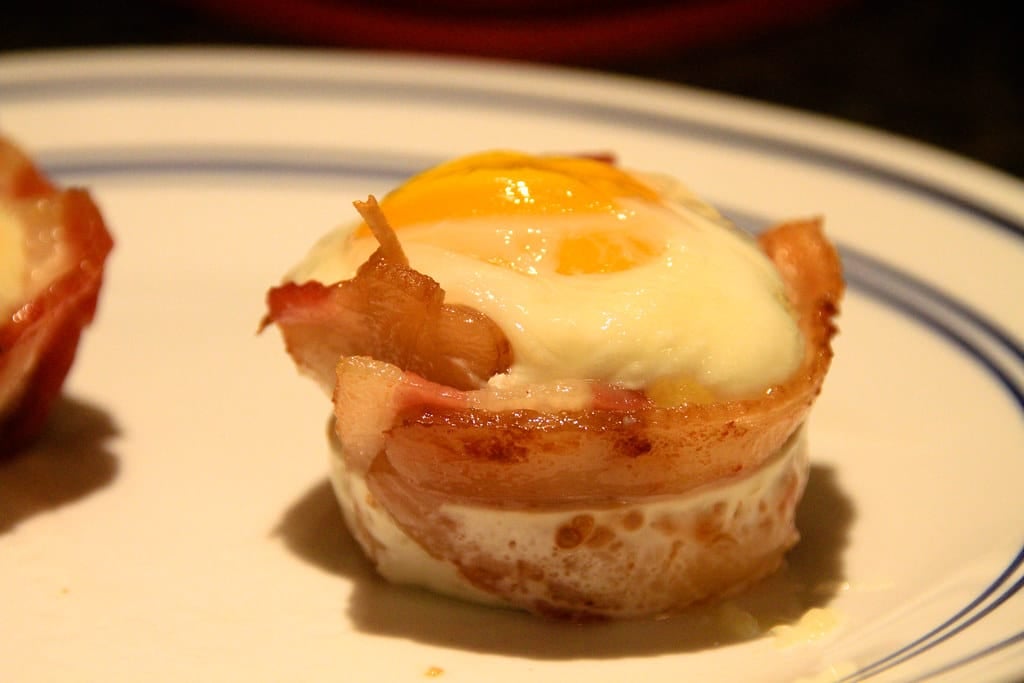
A weekend meal-prep favorite. Bake 4 to 6 cups at once; they hold in the fridge for 3 days. Use a chicken or turkey sausage with under 2 g net carbs per link if you can find it.
Ingredients
- 1 large egg
- 2 slices low-carb chicken or beef sausage (about 30 g)
- 1/2 teaspoon olive oil
- 1 tablespoon shredded cheddar
- pinch paprika
- salt and pepper
Instructions
- Heat oven to 375 F (190 C).
- Grease a ramekin with olive oil.
- Slice sausage; layer bottom of ramekin.
- Crack egg on top; sprinkle cheese, paprika, salt, pepper.
- Place ramekin in a baking dish with hot water halfway up its sides; bake 10 to 12 minutes until whites are just set.
Nutrition (1 serving): 425 kcal, 25 g protein, 3 g total carbs, 3 g net carbs, 36 g fat.
7. Korean-Style Egg Rolls with Cheese (360 kcal, 6 g net carbs)

The impressive-looking one. Layered thin omelets rolled around cheese and mushrooms. Skip the onions and carrots that the traditional version uses to keep net carbs under 10 g.
Ingredients
- 5 large eggs
- 2 tablespoons whole milk
- 2 tablespoons finely chopped green bell pepper
- 2 mushrooms grated
- 1 low-carb sausage link chopped
- 2 tablespoons shredded cheddar
- 1 tablespoon olive oil
- salt
Instructions
- Beat eggs, milk, salt.
- Grease a nonstick skillet lightly with oil.
- Pour 1/3 of egg mixture; cook 90 seconds; scatter half the pepper, mushroom, sausage across the top; sprinkle cheese; roll from one edge to the other with a spatula, leaving half the pan open.
- Add another 1/3 of egg to the empty side, cook, then roll the existing log back into it.
- Repeat with the last 1/3.
- Rest 2 minutes; slice into 6 to 8 pieces.
Nutrition (1 serving of 2): 360 kcal, 25 g protein, 6 g total carbs, 6 g net carbs, 26 g fat.
How to Pick a Low-Carb Breakfast for Your Goal
If you are new to low-carb: start with the Greek yogurt or chia pudding at 7 to 8 g net carbs. The transition is gentler than a strictly ketogenic option under 3 g.
If you are already keto (targeting under 20 g net carbs per day): use the two-egg breakfast salad, fried boiled eggs plus yogurt on the side, or sausage egg cups; each keeps net carbs under 5 g.
If you want the least sugar impact for blood glucose (a common concern in prediabetes and type 2 diabetes, but always coordinate with your care team on medication doses): the egg-based options are the safest starting point.
What the Research Actually Says
Bueno et al. (2013, PMID 23651522) pooled 13 randomized trials of very-low-carb ketogenic diets versus low-fat controls in adults with BMI above 27. At 12 months, the low-carb groups lost about 0.9 kg more on average, with modest improvements in triglycerides and HDL cholesterol.
Effect sizes are real but not dramatic; long-term adherence matters more than the specific carb ceiling.
A separate large systematic review (Naude 2022, PMID 35107970) found no meaningful weight or cardiovascular difference between low-carb and balanced-carb diets when calories were matched.
Translation: low-carb breakfast can be a useful tool, especially for satiety and post-meal blood glucose, but it is not a magic dietary approach.
Meal Prep Tips
- Boil 6 eggs on Sunday. They cover the Turkish salad, fried thyme eggs, and any snack.
- Assemble 4 chia puddings at once. They hold refrigerated 4 days.
- Egg cups freeze. Bake 6, freeze 4 in individual bags; microwave 90 seconds from frozen.
- Buy smoked salmon in vacuum packs. They hold refrigerated up to 3 weeks unopened.
- Weigh cheese and nuts. A “sprinkle” of cheese is often 2 oz (56 g) and 220 kcal.
Frequently Asked Questions
How many carbs is “low carb” for breakfast?
Under 10 g net carbs per meal is a working target for most low-carb patterns. Very-low-carb or ketogenic plans (under 20 to 50 g total per day) usually hold breakfast under 5 g. Standard low-carb (50 to 130 g per day) is more flexible.
Do I need to eat this way to lose weight?
No. Bueno 2013 (PMID 23651522) shows modest 12-month advantages for very-low-carb versus low-fat; Naude 2022 (PMID 35107970) shows no meaningful difference when calories are matched. Low-carb is one useful pattern among several.
Is bacon a good low-carb breakfast?
Bacon is low-carb (near 0 g per slice) and provides fat and protein, but three slices deliver about 400 mg of sodium. Rotate it with lower-sodium options (eggs, smoked salmon, Greek yogurt) rather than eating it daily.
Can I use oatmeal on a low-carb breakfast?
Standard rolled oats deliver about 27 g total carbs per 1/2 cup dry (23 g net after fiber), which is too many for a low-carb target. If you love oat texture, chia pudding or a small (2 tablespoon) serving of hemp hearts gives similar mouthfeel at 3 to 4 g net carbs.
Do I need to count net carbs or total carbs?
In the U.S., “net carbs” is not a regulated term but is widely used to subtract fiber (and often sugar alcohols) from total carbs. For blood-glucose management, watching total carbs is more conservative. For general low-carb eating, net carbs is the more practical number.
Are these recipes keto-friendly?
The two-egg salad, fried thyme eggs, and sausage cups fit a strict ketogenic plan (under 5 g net carbs). Chia pudding, Greek yogurt, and Korean egg rolls sit near 6 to 8 g and work in moderate low-carb but may crowd a strict keto day if you have other carb sources.
What should I drink with these?
Water, black coffee, or unsweetened tea contribute no carbs. Add a splash of unsweetened almond milk or heavy cream (2 tablespoons is about 1 g carb and 100 kcal). Avoid orange juice at 26 g sugar per cup.