Read this first. A low-carb high-fiber diet works for many people, but individual results vary and low-carb diets aren’t appropriate for everyone (pregnancy, certain medications, some medical conditions). Talk to your doctor if you have diabetes, take blood pressure meds, or have kidney disease before starting. If you’re on insulin or an oral hypoglycemic, cutting carbs quickly can drop blood sugar too low. Nothing in this article replaces personalized medical guidance.
Low Carb High Fiber Diet Plan
Low-carb and high-fiber sound like they’d fight each other. Most fiber comes from plants, and plants are usually where the carbs live. But once you subtract fiber from total carbs, a lot of the foods people assume are off-limits on a low-carb plan turn out to fit just fine.
This guide walks through how the math works, which foods pull the most weight, and a sample 7-day plan with fiber counts. It’s built for anyone eating in the 50 to 130 gram net carb range (from a moderate low-carb diet down to keto).
What’s on This Page
- Total carbs vs net carbs
- Why fiber still matters on low-carb
- Carb targets: low-carb, very low-carb, keto
- High-fiber foods that fit
- Foods at a glance (table)
- Sample 7-day meal plan with fiber counts
- Ramping up fiber without GI distress
- Printable version
- FAQ
Is Fiber a Carb? Total vs Net Carbs
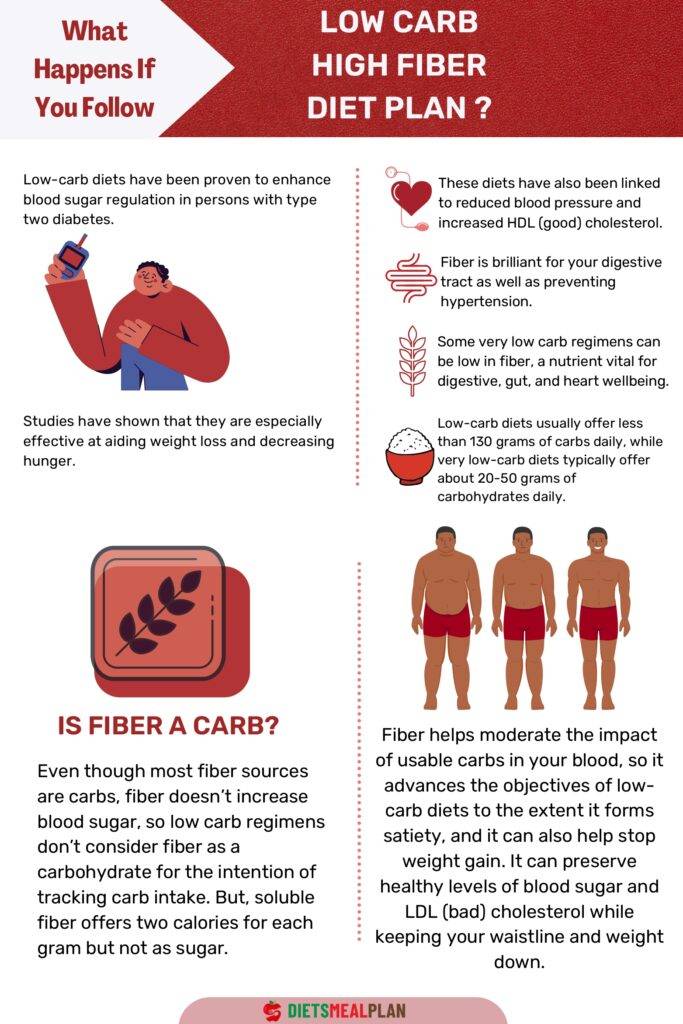
Technically yes, fiber is a carbohydrate. Your body doesn’t absorb it the way it absorbs sugar and starch, though, so it doesn’t raise blood glucose or spike insulin. That’s why most low-carb approaches use net carbs: total carbs minus fiber.
Here’s what that looks like in practice. A cup of raspberries has about 15 g total carbs and 8 g fiber, which comes out to 7 g net. A tablespoon of chia seeds is 5 g total carbs and 4 g fiber, so 1 g net. A big salad packed with leafy greens can be under 5 g net carbs even though it looks like a mountain of plant matter on the plate.
Not every low-carb plan uses net carbs. Atkins does. Standard keto tracking usually does. Some strict clinical protocols count totals instead. Pick a rule and stick with it so you’re comparing apples to apples day over day.
Why Fiber Still Matters on Low-Carb
Cutting carbs doesn’t cut your need for fiber. If anything, it makes fiber more important, because many popular low-carb plates skew toward meat, cheese, and eggs (foods with zero fiber).
Slavin’s 2013 review of fiber and prebiotics summarized the main benefits: healthier bowel function, better satiety, improved LDL cholesterol, a flatter blood-glucose response, and a positive effect on the gut microbiome through short-chain fatty acid production.
What that translates to on a low-carb plan:
- Fewer digestive complaints. Constipation is the most common early complaint on keto. Adequate fiber (with water and electrolytes) largely prevents it.
- Better hunger control. Fiber slows gastric emptying and stretches the stomach, which extends fullness beyond what protein and fat alone can do.
- LDL support. Soluble fiber (from oats, psyllium, chia, flax, legumes, some fruits) binds bile acids and reduces LDL. That matters because some people see LDL rise on a very-low-carb diet.
- Steadier blood sugar. Even with low total carbs, pairing fiber with any carbs you do eat blunts the glucose response.
- A happier gut microbiome. Fermentable fibers feed bacteria that produce short-chain fatty acids, which have measurable effects on inflammation and metabolic health.
Carb Targets: Low-Carb, Very Low-Carb, Keto
“Low-carb” isn’t a single number. Common ranges:
- Moderate low-carb: roughly 100 to 150 g net carbs per day. Room for berries, some legumes, small servings of starchy vegetables, occasional whole grains.
- Very low-carb: roughly 50 to 100 g net carbs per day. Mostly non-starchy vegetables, moderate berries, seeds, nuts.
- Ketogenic: under 50 g net carbs per day (often under 30 g). Fiber sources concentrate in leafy greens, cruciferous vegetables, seeds, avocado, and small portions of low-sugar berries.
A 2013 meta-analysis by Bueno and colleagues compared very-low-carbohydrate ketogenic diets with low-fat diets for long-term weight loss. It found modestly greater weight loss on the ketogenic side over 12 months, along with favorable changes to triglycerides and HDL. The takeaway isn’t that keto is magic. It’s that a well-formulated low-carb diet is a reasonable option for many adults, and fiber intake is one of the levers that separates a well-formulated version from a sloppy one.
High-Fiber Foods That Fit a Low-Carb Plan
Non-Starchy Vegetables
The workhorses. Spinach, kale, arugula, romaine, Swiss chard, bok choy, broccoli, cauliflower, Brussels sprouts, cabbage, zucchini, asparagus, green beans, bell peppers. Most run 2 to 4 g fiber per cooked cup with just a few net carbs.
Seeds
Chia, flax, hemp, and pumpkin seeds have some of the best fiber-to-carb ratios you’ll find. Two tablespoons of chia gives roughly 10 g fiber for 2 g net carbs. Ground flax is similar. Hemp hearts are lower in fiber but bring protein and omega-3s.
Nuts
Almonds, pecans, walnuts, and Brazil nuts all fit. A one-ounce serving of almonds delivers about 3.5 g fiber and 3 g net carbs. Portion matters here (nuts are calorie-dense), but they’re an easy fiber boost.
Berries
Raspberries and blackberries lead the fiber list among common fruits. A cup of raspberries has 8 g fiber and 7 g net carbs. Strawberries and blueberries work too in moderate portions.
Avocado
Half a medium avocado provides about 5 g fiber and roughly 2 g net carbs. It’s also a source of monounsaturated fat and potassium, both useful on a low-carb plan.
Psyllium Husk
The most concentrated supplemental fiber that’s compatible with low-carb. A tablespoon of psyllium husk delivers roughly 5 g soluble fiber with almost no net carbs. Useful when you’re consistently short of your target. Drink plenty of water with it.
High-Fiber Low-Carb Foods at a Glance
Save as PDF| Food | Portion | Fiber (g) | Net carbs (g) |
|---|---|---|---|
| Chia seeds | 2 tbsp | 10 | 2 |
| Ground flaxseed | 2 tbsp | 4 | 0 |
| Raspberries | 1 cup | 8 | 7 |
| Blackberries | 1 cup | 8 | 6 |
| Avocado | 1/2 medium | 5 | 2 |
| Broccoli, cooked | 1 cup | 5 | 6 |
| Brussels sprouts, cooked | 1 cup | 4 | 7 |
| Spinach, raw | 2 cups | 1.5 | 0.5 |
| Almonds | 1 oz (~23) | 3.5 | 3 |
| Psyllium husk | 1 tbsp | 5 | 1 |
Numbers are approximate. Check labels and USDA data for specifics.
Sample 7-Day Meal Plan (~1,500 kcal, 28 to 35 g Fiber Daily)
Adapted from the original 7-day layout, with rough fiber totals per day so you can see where the fiber actually comes from. Portion up or down to match your calorie needs. If you’re eating keto (under 50 g net carbs), drop the oatmeal, the pear, the clementine, and the small squash portions and lean harder on the seed and avocado items.
Day 1 (~32 g fiber)
- Breakfast: Green smoothie with spinach, half an avocado, chia seeds, unsweetened almond milk, and protein powder
- Lunch: Half avocado with sliced pear on a slice of low-carb seed bread, plus mixed greens
- Snack: Small handful of walnut halves
- Dinner: Roasted chicken over mixed greens with cucumber and olive oil dressing
Day 2 (~35 g fiber)
- Breakfast: Apple-cinnamon chia pudding (chia + unsweetened almond milk + cinnamon + small diced apple)
- Lunch: Shaved Brussels sprouts salad with crispy chickpeas and lemon
- Snack: Small portion of baked banana-nut oatmeal
- Dinner: Chickpea and spinach stew
Day 3 (~30 g fiber)
- Breakfast: Half cup low-fat Greek yogurt with 2 tbsp ground flax and a handful of berries
- Lunch: Chicken fajita bowl with peppers, onions, and guacamole (skip the tortilla or use one low-carb wrap)
- Snack: 20 dry-roasted almonds
- Dinner: Slow-cooked turkey chili with butternut squash (small squash portion)
Day 4 (~33 g fiber)
- Breakfast: Chia pudding with raspberries
- Lunch: Turkey chili leftovers with a green salad
- Snack: One clementine
- Dinner: Roasted pork tenderloin with roasted broccoli and cauliflower “rice” (swap the quinoa if you’re strict low-carb)
Day 5 (~28 g fiber)
- Breakfast: Green smoothie (as Day 1)
- Lunch: Beef and broccoli stir-fry over shirataki or low-carb noodles
- Snack: Small apple
- Dinner: Big salad with avocado, shallots, and maple-balsamic vinaigrette; add chicken or salmon
Day 6 (~34 g fiber)
- Breakfast: Chia pudding
- Lunch: Shaved Brussels sprouts salad with crispy chickpeas
- Snack: Sliced bell pepper with a small portion of hummus
- Dinner: Chicken with spinach in a light Alfredo-style cream sauce
Day 7 (~30 g fiber)
- Breakfast: Green smoothie
- Lunch: Leftover chicken with spinach over greens
- Snack: One small pear
- Dinner: Roasted pork tenderloin with cauliflower rice and green beans
Ramping Up Fiber Without GI Distress
Doubling fiber overnight is a fast track to bloating and cramping. Ramp gradually:
- Add about 5 g of fiber every few days, not all at once.
- Drink more water. Fiber needs fluid to move through you.
- Chew thoroughly, especially seeds and nuts.
- If you use psyllium, start with a teaspoon and work up.
- Time fiber-heavy meals earlier in the day if evening bloating bothers you.
Weickert and Pfeiffer’s 2018 review on fiber and insulin resistance is a good reminder that most of fiber’s metabolic benefit shows up over weeks, not days. Consistency beats a single high-fiber day.
Printable Low Carb High Fiber Diet Plan
| Low Carb High Fiber Diet Plan | |
|---|---|
| Day 1 | |
| Breakfast | Green smoothie with spinach, avocado, chia |
| Lunch | Avocado + pear on low-carb seed bread; mixed greens |
| Snack | ~8 walnut halves |
| Dinner | Roasted chicken over mixed greens |
| Day 2 | |
| Breakfast | Apple-cinnamon chia pudding |
| Lunch | Shaved Brussels sprouts salad + crispy chickpeas |
| Snack | Small portion baked banana-nut oatmeal |
| Dinner | Chickpea and spinach stew |
| Day 3 | |
| Breakfast | Greek yogurt + ground flax + berries |
| Lunch | Chicken fajita bowl with guacamole |
| Snack | 20 dry-roasted almonds |
| Dinner | Turkey chili with butternut squash |
| Day 4 | |
| Breakfast | Chia pudding with raspberries |
| Lunch | Turkey chili leftovers + green salad |
| Snack | One clementine |
| Dinner | Pork tenderloin + roasted broccoli + cauliflower rice |
| Day 5 | |
| Breakfast | Green smoothie |
| Lunch | Beef and broccoli stir-fry over shirataki noodles |
| Snack | Small apple |
| Dinner | Big salad with avocado + maple-balsamic dressing |
| Day 6 | |
| Breakfast | Chia pudding |
| Lunch | Brussels sprouts salad + chickpeas |
| Snack | Bell pepper strips + hummus |
| Dinner | Chicken with spinach in light cream sauce |
| Day 7 | |
| Breakfast | Green smoothie |
| Lunch | Leftover chicken + spinach over greens |
| Snack | One small pear |
| Dinner | Pork tenderloin + cauliflower rice + green beans |
FAQ
Should I count net carbs or total carbs?
Most low-carb frameworks (Atkins, standard keto tracking) use net carbs. Some clinical or therapeutic protocols count total. Pick one and be consistent. For weight loss and general metabolic health, net carbs is the more practical measure.
How much fiber should I aim for on a low-carb diet?
The Dietary Guidelines suggest roughly 25 g per day for women and 38 g per day for men. Most people fall well short. Hitting 25 to 35 g while eating low-carb is a realistic and effective target.
Can I hit high fiber on keto (under 50 g net carbs)?
Yes, but it takes planning. Chia and flax seeds, avocado, leafy greens, cruciferous vegetables, and a modest psyllium supplement can get you into the 25 to 35 g range without breaking ketosis.
Do beans and legumes fit?
They fit on moderate low-carb (100 to 150 g net) but crowd out other carbs quickly on keto. Half a cup of black beans is roughly 20 g net carbs.
Which fruits are lowest in carbs?
Raspberries and blackberries are the top pick for fiber-to-carb ratio. Strawberries are also low. Bananas, mangoes, and grapes are much higher in sugar and are usually cut back or eliminated on stricter plans.
Do I need a fiber supplement?
Not necessarily, but psyllium husk is useful if you’re consistently short. Start small, drink plenty of water, and note that some people react better to soluble fiber supplements than to insoluble ones.
I’m constipated on keto. What now?
Very common early on. Increase fluid, add magnesium (many people are low on it), get more leafy greens, and consider a teaspoon of psyllium daily. If it persists more than a couple of weeks, talk to your doctor.
Related Reading
- High Fiber Diet Food List
- High Fiber Diet Plan
- Low Fiber Foods List
- Irritable Bowel Syndrome High Fiber Diet
- Hemorrhoids High Fiber Diet
- Low Carb Smoothie Recipes