Medical Disclaimer: This article is for informational purposes only and is not a substitute for professional medical advice, diagnosis, or treatment.
Always consult a registered dietitian, physician, or qualified healthcare provider before making significant changes to your diet, especially if you have a medical condition, take medication, are pregnant or nursing, or are managing a chronic illness. Individual results may vary.
1000-Calorie Meal Plan: An Honest 7-Day Guide
A 1000-calorie meal plan is a short low-calorie diet that can produce fast weight loss for small-framed adults or as a 1 to 4 week reset for larger adults, but 1000 kcal sits below the basal metabolic rate (BMR) of most people and is generally not appropriate as a long-term way of eating.
The National Institutes of Health defines Very Low Calorie Diets as under 800 kcal/day and recommends medical supervision; the 1000-kcal band is a Low Calorie Diet (LCD) and still benefits from clinician oversight if used for more than a few weeks (1).
This guide gives you a balanced 7-day plan with per-meal macros and honest expectations.
Who a 1000-Calorie Plan Fits (and Who It Does Not)
- Better fit: shorter adults (under about 5’4″) aiming for slow steady loss; adults with a BMI over 27 doing a supervised 4 to 8 week reset; anyone with a clinician-set target below their BMR for a specific medical reason.
- Poor fit: adults with an estimated BMR above 1400 kcal (most men, taller and active women), athletes in training, adolescents, pregnant or breastfeeding people, adults over 65 without clinician oversight, anyone with a history of disordered eating, and anyone under 18.
- Never a fit: as a permanent maintenance diet. Continuous eating below BMR drives loss of muscle, bone density, thyroid function, and reproductive-hormone signaling.
If you weigh over 180 lb, are male, or are training hard, 1000 kcal is probably too low. Consider 1200 to 1500 kcal instead.
A moderate deficit of 250 to 500 kcal below maintenance is what produces the best long-term outcomes in most reviews of behavioral weight-loss programs (2).
How To Structure a 1000-Calorie Day
- Protein: 70 to 90 g/day. Protein is the single most important macro at this calorie level – it protects lean mass, blunts hunger, and has the highest thermic effect.
- Carbs: 100 to 130 g/day, weighted toward fiber-rich sources (vegetables, berries, oats, legumes, whole grain).
- Fat: 25 to 35 g/day, weighted toward mono- and polyunsaturated (olive oil, avocado, nuts, fatty fish).
- Fiber: aim for 25 g/day. This is the single biggest hunger management lever.
- Water: at least 8 cups. Thirst is often mistaken for hunger, especially in a deficit.
Foods To Prioritize and Foods To Limit
- Prioritize: lean chicken and turkey, plain Greek yogurt, cottage cheese, eggs, fish, tofu, lentils, chickpeas, oats, berries, non-starchy vegetables, leafy greens, olive oil, nuts and seeds in small portions.
- Limit: sugary drinks, juice, alcohol, refined baked goods, packaged snack foods, dressings and sauces higher than 100 kcal per serving. At 1000 kcal you cannot afford calorie-dense low-nutrient items in more than a token amount.
7-Day 1000-Calorie Meal Plan
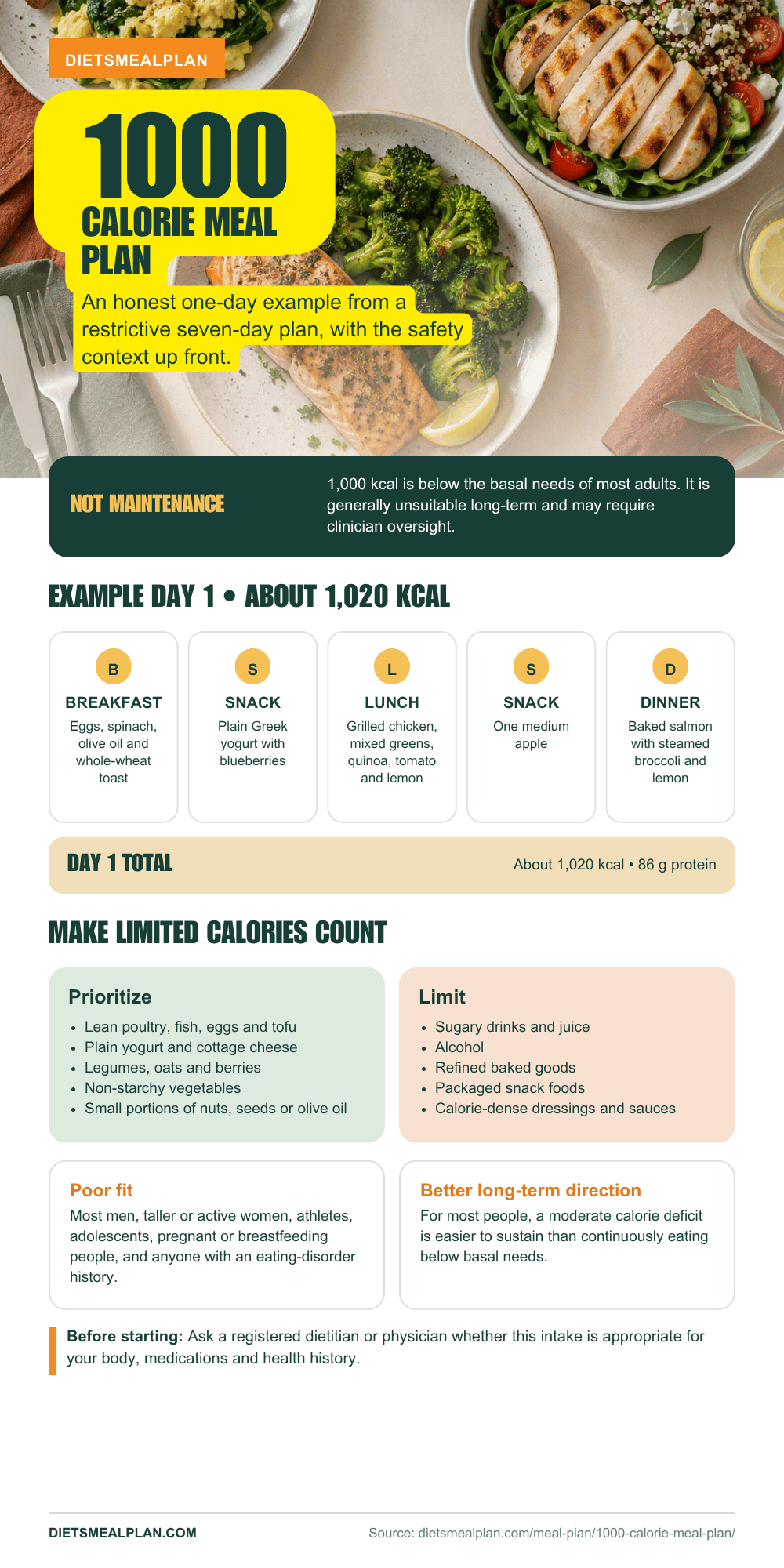
Day 1 (~1,000 kcal)
- Breakfast: 2 large eggs scrambled with 1 cup wilted spinach and 1 tsp olive oil, 1 slice whole-wheat toast (28 g). 270 kcal, 16 g protein, 15 g carb, 16 g fat.
- Snack: 6 oz plain non-fat Greek yogurt (170 g) with 1/2 cup blueberries. 135 kcal, 17 g protein, 15 g carb, 0 g fat.
- Lunch: 3 oz (85 g) grilled chicken over 2 cups mixed greens, 1/4 cup cooked quinoa (50 g), cherry tomato, 1 tsp olive oil, lemon. 295 kcal, 30 g protein, 22 g carb, 10 g fat.
- Snack: 1 medium apple (180 g). 90 kcal, 0 g protein, 24 g carb, 0 g fat.
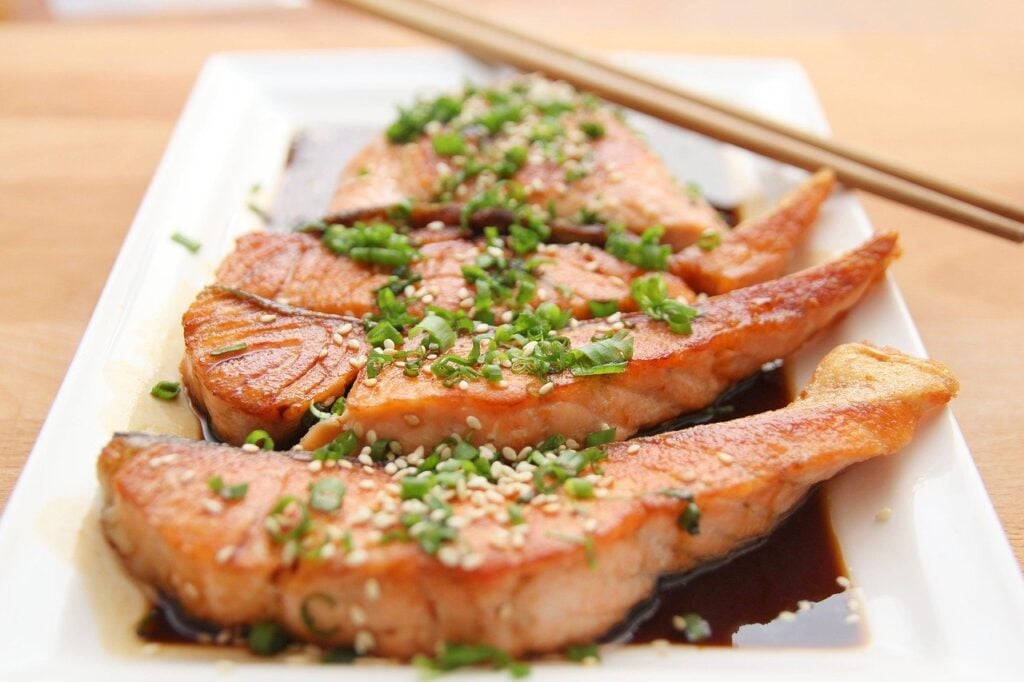
- Dinner: 3 oz (85 g) baked salmon, 1 cup steamed broccoli (150 g), lemon. 230 kcal, 23 g protein, 10 g carb, 12 g fat.
- Daily total: 1,020 kcal, 86 g protein, 86 g carb, 38 g fat.
Day 2 (~985 kcal)
- Breakfast: 1/2 cup dry rolled oats (40 g) cooked in 1/2 cup skim milk with 1 tbsp peanut butter and 1/2 sliced banana (60 g). 295 kcal, 12 g protein, 45 g carb, 9 g fat.
- Snack: 1/2 oz raw almonds (14 g, about 12 nuts). 80 kcal, 3 g protein, 3 g carb, 7 g fat.
- Lunch: 4 oz (115 g) water-pack tuna over 2 cups mixed greens with 1/4 cup chickpeas (40 g cooked), cucumber, 1 tsp olive oil. 280 kcal, 33 g protein, 15 g carb, 10 g fat.
- Snack: 1 small pear (150 g). 85 kcal, 0.5 g protein, 22 g carb, 0 g fat.
- Dinner: 4 oz (115 g) lean ground turkey, 1 cup green beans (125 g), 1 tsp olive oil, garlic. 240 kcal, 27 g protein, 10 g carb, 10 g fat.
- Daily total: 980 kcal, 76 g protein, 95 g carb, 36 g fat.
Day 3 (~1,015 kcal)
- Breakfast: 4 oz (115 g) plain non-fat Greek yogurt, 1 cup sliced strawberries, 1 slice whole-grain toast (28 g). 200 kcal, 17 g protein, 30 g carb, 1 g fat.
- Snack: 1 medium apple (180 g). 95 kcal, 0.5 g protein, 25 g carb, 0 g fat.
- Lunch: 3 oz (85 g) grilled chicken, 1 cup steamed cauliflower (100 g), 1/2 cup cooked brown rice (100 g), 1 tsp olive oil. 295 kcal, 29 g protein, 30 g carb, 8 g fat.
- Snack: 1/2 oz pumpkin seeds (14 g, about 2 tbsp). 85 kcal, 4 g protein, 3 g carb, 7 g fat.
- Dinner: 4 oz (115 g) pan-seared firm tofu, 1 cup roasted bell peppers (150 g), 1/2 cup cooked lentils (100 g). 340 kcal, 25 g protein, 40 g carb, 12 g fat.
- Daily total: 1,015 kcal, 75 g protein, 128 g carb, 28 g fat.
Day 4 (~995 kcal)
- Breakfast: 1 large egg poached, 1 slice whole-grain toast (28 g), 1 medium tomato sliced with black pepper. 200 kcal, 10 g protein, 20 g carb, 8 g fat.
- Snack: 1/2 oz pumpkin seeds (14 g). 85 kcal, 4 g protein, 3 g carb, 7 g fat.
- Lunch: 4 oz (115 g) tuna in water over 2 cups mixed greens, 1/4 cup chickpeas (40 g cooked), cucumber, 1/4 medium avocado (35 g). 310 kcal, 30 g protein, 15 g carb, 15 g fat.
- Snack: 4 oz plain non-fat Greek yogurt (115 g). 65 kcal, 12 g protein, 4 g carb, 0 g fat.
- Dinner: 3 oz (85 g) grilled chicken, 1 cup roasted asparagus (135 g), 1/2 cup cooked wild rice (80 g), 1 tsp olive oil. 320 kcal, 28 g protein, 30 g carb, 10 g fat.
- Daily total: 980 kcal, 84 g protein, 72 g carb, 40 g fat.
Day 5 (~1,010 kcal)
- Breakfast: 2-egg omelette with 1 cup wilted spinach and 1 oz feta (28 g). 270 kcal, 20 g protein, 4 g carb, 20 g fat.
- Snack: 6 oz plain non-fat Greek yogurt (170 g) with 1/4 cup blueberries. 115 kcal, 17 g protein, 10 g carb, 0 g fat.
- Lunch: 4 oz (115 g) lean ground turkey with 1 cup mashed cauliflower (200 g) and 1 tsp olive oil. 250 kcal, 27 g protein, 12 g carb, 10 g fat.
- Snack: 1 small orange (140 g). 65 kcal, 1 g protein, 15 g carb, 0 g fat.
- Dinner: 3 oz (85 g) baked salmon, 1 cup steamed broccoli (150 g), 1/4 cup cooked quinoa (50 g), lemon. 295 kcal, 25 g protein, 20 g carb, 12 g fat.
- Daily total: 995 kcal, 90 g protein, 61 g carb, 42 g fat.
Day 6 (~1,005 kcal)
- Breakfast: 2 large eggs scrambled, 1 medium tomato, 1/2 slice whole-grain toast (14 g). 210 kcal, 14 g protein, 12 g carb, 12 g fat.
- Snack: 4 oz plain non-fat Greek yogurt (115 g) with 1/2 cup strawberries. 90 kcal, 12 g protein, 10 g carb, 0 g fat.
- Lunch: 3 oz (85 g) grilled chicken, 2 cups mixed greens, 1/2 cup mashed cauliflower, 1/4 cup cooked brown rice (50 g), 1 tsp olive oil. 295 kcal, 30 g protein, 30 g carb, 8 g fat.
- Snack: 1 small apple (150 g). 75 kcal, 0 g protein, 20 g carb, 0 g fat.
- Dinner: 3 oz (85 g) baked salmon, 1 cup roasted bell peppers (150 g), 1 cup asparagus (135 g). 250 kcal, 24 g protein, 15 g carb, 12 g fat.
- Daily total: 920 kcal, 80 g protein, 87 g carb, 32 g fat. Add 1/2 oz almonds or 1 additional fruit for a fuller 1000.
Day 7 (~1,000 kcal)
- Breakfast: 1 cup low-fat cottage cheese (225 g) with 1 cup sliced strawberries and 1 tsp chia. 250 kcal, 30 g protein, 18 g carb, 4 g fat.
- Snack: 1/2 oz raw almonds (14 g) and 1 small clementine (75 g). 110 kcal, 3 g protein, 12 g carb, 7 g fat.
- Lunch: 4 oz (115 g) tuna in water over 2 cups mixed greens, 1/4 medium avocado (35 g), 1 tsp olive oil, lemon. 270 kcal, 30 g protein, 8 g carb, 15 g fat.
- Snack: 1 medium apple (180 g). 95 kcal, 0.5 g protein, 25 g carb, 0 g fat.
- Dinner: 3 oz (85 g) grilled chicken, 1 cup roasted cauliflower (100 g), 1 cup roasted red peppers (150 g). 240 kcal, 28 g protein, 20 g carb, 8 g fat.
- Daily total: 965 kcal, 92 g protein, 83 g carb, 34 g fat.
7-Day Comparison Summary
Save as PDF| Day | Total kcal | Protein (g) | Carbs (g) | Fat (g) |
|---|---|---|---|---|
| 1 | 1,020 | 86 | 86 | 38 |
| 2 | 980 | 76 | 95 | 36 |
| 3 | 1,015 | 75 | 128 | 28 |
| 4 | 980 | 84 | 72 | 40 |
| 5 | 995 | 90 | 61 | 42 |
| 6 | 920 | 80 | 87 | 32 |
| 7 | 965 | 92 | 83 | 34 |
Realistic Weight-Loss Expectations
Over a 4-week 1000-kcal reset, healthy adults commonly lose 6 to 12 lb, with faster loss in the first week (mostly water and glycogen) and slower steady loss thereafter. Sustainable body-fat loss caps at about 1 to 1.5 kg per week.
If a source promises significantly more, treat that as marketing, not physiology. If you weigh 250 lb or more, initial losses can be higher; if you weigh under 150 lb, losses can be slower and dropping below 1000 kcal is not the answer.
Transitioning Off a 1000-Calorie Plan
- After 4 to 6 weeks, step up to 1200 to 1400 kcal for 2 weeks, then 1400 to 1700 kcal for maintenance, adjusted for body size and activity.
- Keep protein at 1.2 to 1.6 g per kg body weight during the step-up to preserve lean mass.
- Add resistance training 2 to 3 days per week to reinforce muscle retention.
- Track weekly, not daily. The scale is noisy day to day.
Frequently Asked Questions
Is 1000 calories a day safe?
For short (1 to 4 week) supervised use in adults with obesity or overweight, it can be safe. Continuous long-term use without medical oversight risks muscle loss, gallstones, electrolyte imbalance, thyroid slowdown, and menstrual changes (1).
If you take insulin, sulfonylureas, blood pressure medication, or thyroid medication, your prescriber should adjust doses in advance.
How much weight will I lose on 1000 calories a day?
Roughly 1 to 2 pounds per week sustained, with faster loss in the first week. Total loss over a 4-week reset is commonly 6 to 12 lb depending on starting weight and activity.
How long can I stay on a 1000-calorie diet?
Most clinician-endorsed low-calorie protocols cap the intensive phase at 12 weeks. Self-directed use should be limited to 4 to 6 weeks, followed by a step-up to 1400 to 1700 kcal for maintenance.
Do I need supplements?
A standard adult multivitamin is a reasonable default at this calorie level. If you eat little dairy, calcium and vitamin D deserve attention. If you follow the plan mostly plant-based, add B12.
Can I exercise on 1000 calories?
Light activity (walking, easy yoga, mobility work) is fine and helpful. Heavy resistance or long endurance sessions at 1000 kcal accelerate muscle loss; either bump calories on training days or scale training back.
What if I feel dizzy, cold, or foggy?
Those are common signs the calorie level is too low for you, especially if persistent past week 2. Increase to 1200 to 1400 kcal and contact your clinician if symptoms continue.
Can I use this plan while pregnant, breastfeeding, or under 18?
No. Pregnancy, lactation, and growth need substantially more calories and specific nutrients. Speak with a prenatal or pediatric dietitian.
Disclaimer
1000 kcal per day is below the basal metabolic rate of most adults and is not appropriate as a long-term way of eating. This article is educational and does not replace an individualized care plan from a qualified clinician. Do not follow this plan if you are pregnant, nursing, under 18, over 65 without oversight, have a history of disordered eating, or take diabetes, blood pressure, or thyroid medication without physician review. Not medical advice.