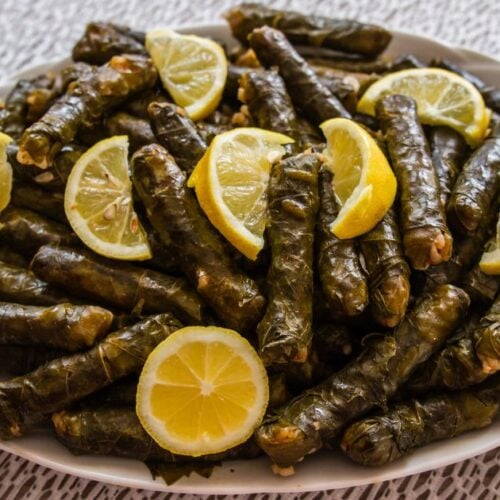
Stuffed Grape Leaves Recipe
It has a lot of ingredients, and it causes some dirty dishes, but when the meal is cooked, you become one of the most famous Turkish chefs. Your guests or household will be amazed at how this delicacy is created.
Ingredients
- 55 grape leaves fresh or pickled
- 3 garlic cloves
- 5 tbsp. vegetable oil
- 1 tbsp. dried mint
Filling
- 1 cup baldo rice
- 1/2 small onion
- 3 garlic cloves
- 1 1/2 tbsp. pomegranate molasses
- 15 leaves fresh mint chopped
- 5 tbsp. fresh parsley chopped
- 3 tbsp. vegetable oil
- 2 tbsp. olive oil
- 1 1/2 tbsp. tomato paste
- 1/2 tbsp. pepper paste
- 1/2 tbsp. sugar
- 1 tbsp. chili flakes
- 1 1/2 tsp.Pepper
- Salt to taste
Instructions
Stuffed Grape Leaves Recipe with Pickled Leaves
- Pickled leaves contain extra salt, which can make your food too salty. So start by removing this salt. Wash your pickled leaves with plenty of water without damaging them.
- Fill a large bowl with hot water. Put the leaves in the water. Soak for 10 minutes, pour out the water, fill the bowl with clean hot water, put the leaves in again, and let them sit for another 10 minutes.
- Repeat this process at least 5 times. Wash the leaves one last time with plenty of water; they are now free of extra salt.
Stuffed Grape Leaves Recipe with Fresh Leaves
- If you prepare stuffed grape leaves with fresh leaves, take a large pot on the stove.
- Add boiled water to it and turn on the stove. Boil until the leaves turn from green to yellow.
- Recommendation: Fresh leaves only need to boil for 5–10 minutes. When the leaves turn a little yellow and become easy to wrap, take them out of the water and drain the excess water.
- Your pickled or fresh leaves are now ready. Set them aside, and you can start preparing the filling.
- Put 1 tbsp. of oil in a pan, add the thoroughly washed and drained rice to the pan, and fry for 3–5 minutes.
- Take the fried rice into a deep bowl.
- Add finely chopped onion, tomato paste, pepper paste, 3 cloves of grated garlic, pomegranate molasses, chopped mint, chopped fresh parsley, 3 tbsp vegetable oil, 2 tbsp olive oil, some sugar, salt, and filling seasonings to the rice.
- Mix them well. The filling should look shiny because of the oil, but add more olive oil if it still has a dry and matte appearance. Keep the filling aside.
- Lay 5 grape leaves on the bottom of a deep and large pot. Keep the pot aside. If your leaves have stems, cut them gently with a knife. Lay a leaf on a flat surface. Put a small amount of filling on it.
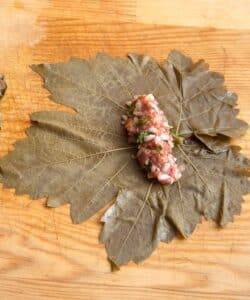
- Tip: Do not add too much filling. The rice will swell during cooking. If you overfill, the rice will stay raw and the leaves won’t cook evenly.
- Wrap the right side of the leaf first, then the left side, after folding it over the filling. (Just like in the image below).
- Wrap the right side of the leaf first, then the left side, after folding it over the filling. (Just like in the image below)
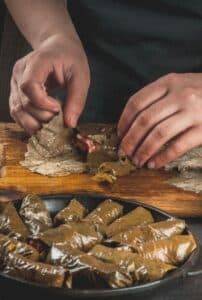
- The longer and thinner you spread the filling over the leaf, the thinner and longer your stuffed grape leaves will appear. Then wrap it up.
Tip: Avoid wrapping too tightly or too loosely. If wrapped too loosely, the leaves will open during cooking and the filling will fall apart. If wrapped too tightly, the rice won’t be able to expand as it cooks.
- When you get 10 Turkish dolmas, bring them together, wrap them with a few turns of sewing thread without tightening too much, and put them in the pot.
- Keep wrapping until all the leaves are used. Every time you have 10, secure them with sewing thread and place them in the pot.
- You will have made 5 groups of 10. Put all the dolma packs in the pot. Then add 1 tsp of tomato paste into 1/4 cup of water and mix.
- Pour the tomato paste water over the dolmas.
- Slice 3 garlic cloves thickly and place them randomly in the pot.
- Turn on the stove, and when the tomato paste water starts to boil, continue cooking on the lowest heat with the lid closed.
- Cook on low heat for 45 minutes to 1 hour. Check often. When the water at the bottom evaporates, add a little more water (you don’t need to add tomato paste each time).
- Recommendation: At the end of 45 minutes, take 1 dolma from the pot and taste it. If the rice and leaves are fully cooked and everything is easily chewable, the meal is done.
- Heat 5 tbsp vegetable oil in a small saucepan, add dried mint, fry for a few seconds, and drizzle the mint oil over the cooked dolmas.
- Close the lid of the pot immediately. Turn off the stove and keep the lid closed for 1 hour.
- They’ll be ready after 1 hour of resting. Serve with Greek yogurt for the best presentation. The stuffed grape leaves recipe will be worth all the preparation, and you’ll thank us later.
Video
Nutrition
Serving: 1gCalories: 353kcalCarbohydrates: 24gProtein: 4gFat: 28gSaturated Fat: 3gPolyunsaturated Fat: 24gTrans Fat: 1gCholesterol: 0mgSodium: 1381mgFiber: 6gSugar: 7g
Tried this recipe?Let us know how it was!